
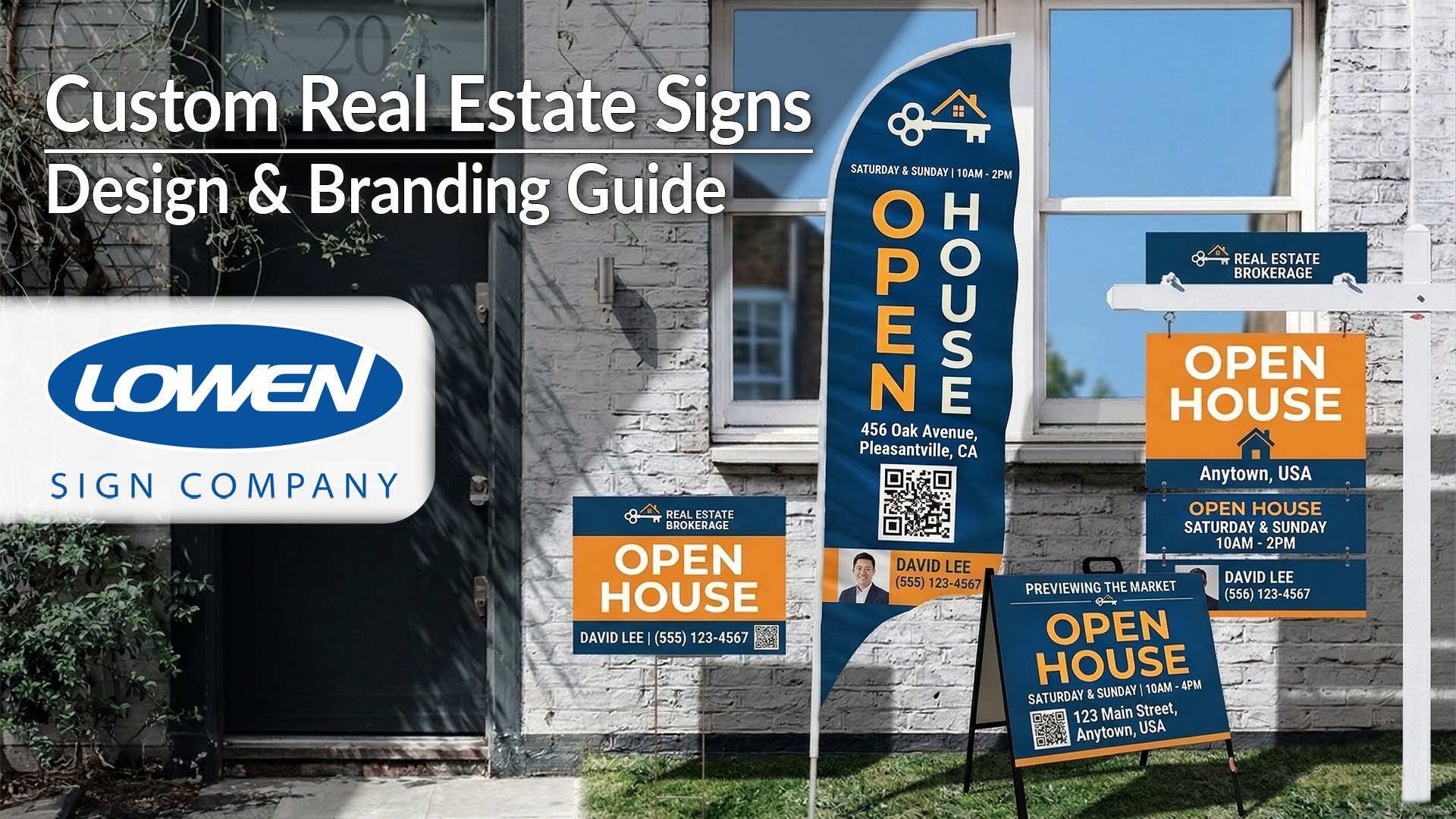
Custom Real Estate Signs: A Design & Branding Guide for Agents
Design decisions that make a custom sign work: what goes on it, where the logo sits, which material to pick, and how the custom design process runs.
Your yard sign is often the first physical impression a buyer has of you and for an independent agent, it's the one marketing asset you control completely. Custom real estate signs turn that impression into brand equity: instead of borrowing a franchise's recognition, every install builds your name. This guide covers how to design one, what to put on it, and how to get it produced.
What are custom real estate signs?
Custom real estate signs are original designs built for an individual agent or independent brokerage rather than pulled from a corporate template. You control the color palette, typography, logo, layout, size, and material. That's the dividing line from franchise-approved signage, where corporate branding leads and personalization is limited to your name, photo, and contact details. Both have a place; the right choice depends on how you're building your business.
Custom vs. franchise-approved: which is right for you?
Choose franchise-approved signage if you're affiliated with a national brand (RE/MAX, Keller Williams, Century 21, Coldwell Banker, Berkshire Hathaway HomeServices), you're in your first year or two, or your market runs on franchise brand loyalty. You gain instant recognition and corporate marketing support, and you order from your brokerage's brand-compliant catalog. See available brands in the Brokerage Catalog Selector.
Choose custom signs if you're an independent agent or boutique brokerage, you've built personal-brand recognition worth protecting, or you compete in a market where standing out drives listings. You trade the franchise's built-in equity for complete creative control and ownership of your brand assets. Most established independents make this move within their first couple of years; the question is timing, not whether. See options in the Independent Realtor Product Catalog.
What should a custom real estate sign include?
Drivers get about three seconds. Design for that, in priority order:
Lead with a Rider from the Sign Riders Product Catalog showing the property status ("FOR SALE"/"SOLD"), readable from across the street. Attach the rider to a unit with your identity: name, brokerage, and an optional headshot; so buyers recognize you across listings. Then contact info, with the phone number as the biggest contact element since most calls come from a phone at the curb; a website URL and an optional QR code linking to the listing round it out. Keep supporting elements (tagline, credentials, social handles) subtle so they reinforce rather than clutter. Browse Units in the Complete Yard Sign Units Product Catalog.
A few design rules that hold up: use high-contrast sans-serif type for the critical lines, keep a tagline to a few words, and reserve script fonts for accents only; never for a phone number.
How do you integrate a logo the right way?
Your logo is the visual anchor, so it has to hold up at sign scale. Supply it in vector format (AI, EPS, or print-ready PDF) so it stays crisp at any size, and make sure it reads at a glance and works in a single color and reversed on a dark background. Placement is usually top-center for logo-led brands or a top corner for photo-heavy layouts. As a rule of thumb, the logo should occupy no more than 15 to 20% of the sign, recognition not domination, and use consistent Pantone (PMS) colors so it matches your cards, site, and riders.
Which material should you choose?
Match the material to how the sign will be used. Corrugated plastic (coroplast) is the lightweight, cost-effective workhorse for everyday listings; aluminum composite is the step up for luxury positioning or longer-term installs; steel-based panels carry reflective and premium options. Our guide to the best real estate sign material breaks down the trade-offs in detail, and you can spec any of them on our Complete Yard Sign Units Product Catalog.
What does the custom design process look like?
It runs in four steps: a discovery conversation about your market, brand assets, and quantities; concept development with two or three directions shown as digital mockups; one or two rounds of revision; then final approval and print-ready file prep. Accepted print-ready formats are vector AI, EPS, or PDF in CMYK with fonts outlined. Avoid JPGs and low-resolution web graphics.
What if you're a franchise agent who wants to customize?
You can still personalize within brand guidelines: name, title, photo, contact info, credentials, and often a material upgrade or an approved layout variation. What you can't touch is the franchise logo, approved color set, or core layout. Always submit mockups to your corporate compliance team and get written approval before production. When you're ready, order from your brand-compliant catalog rather than a fully custom design.
Why custom signage pays off
Template signs cost less up front but build no equity and get redesigned constantly. Custom designs are a reusable brand asset: past clients recognize your signs, buyers remember you, and that recognition compounds into referrals. Signs that match your cards, site, and social also make you look like the established professional you're asking clients to trust with their biggest transaction.
Ready to build your brand?
Every Lowen sign is made in-house in the USA with production in as little as three days, and there's no minimum order; start with one and reorder as listings come in. Browse our Independent Real Estate Signs Product Catalog, add matching riders from the Sign Riders Product Catalog and panels from Custom Real Estate Sign Panels Product Catalog.
Browse Independent Real Estate Signs & Frames
Frequently Asked Questions about Custom Real Estate Signs:
What are custom real estate signs?
Original signs designed for one agent or independent brokerage: you control the colors, logo, typography, layout, size, and material. Rather than a franchise template that usually only lets you drop in your name, contact info, and photo.
How much do custom real estate signs cost?
Pricing depends on size, material, and quantity, with volume discounts shown on each product page. There's no minimum order, so you can start with a single sign.
How long does it take to get custom signs?
Standard production is as little as three business days after artwork approval, plus shipping transit time from central Kansas.
Can I use my own design?
Yes, send print-ready vector files (AI, EPS, or PDF: CMYK and with fonts outlined) through our Contact Us page, or work with the design team to build artwork from scratch.
Can franchise agents order custom signs?
Franchise agents personalize within brand guidelines and order from their brand-compliant catalog; fully custom designs require written approval from corporate. Independent agents have complete freedom.
What material is best for a custom sign?
Corrugated plastic for cost-effective everyday listings, aluminum composite for luxury or longer-term use, or steel for maximum durability.